7 Tips for Choosing the Best Charcuterie Board Set?
A Charcuterie Board Set can turn a few cheeses, cured meats, and seasonal fruit into a welcoming centerpiece. The right set makes serving easier, too. A stable board gives soft brie room to spread, while small bowls keep olives and honey from running into the crackers. Still, attractive photos do not tell you everything. Board size, wood care, utensil quality, and storage matter once guests arrive.
Charcuterie educator Marissa Mullen, author of That Cheese Plate Will Change Your Life, is known for building boards around variety and visual balance. A concise editorial summary of that approach—not a verbatim quotation—is: “Pair contrasting flavors, and make every choice easy to reach.” That idea helps guide this look at seven practical buying tips. We’ll consider materials, board dimensions, included knives, serving bowls, and ease of cleaning. We’ll also look at how a set fits your table and budget. Small details count. A handle can make carrying easier; a cramped surface can make slicing awkward. No set is perfect for every home, and a larger board is not always better. Use these tips to compare real features, notice trade-offs, and choose a set you’ll enjoy using beyond a single gathering.
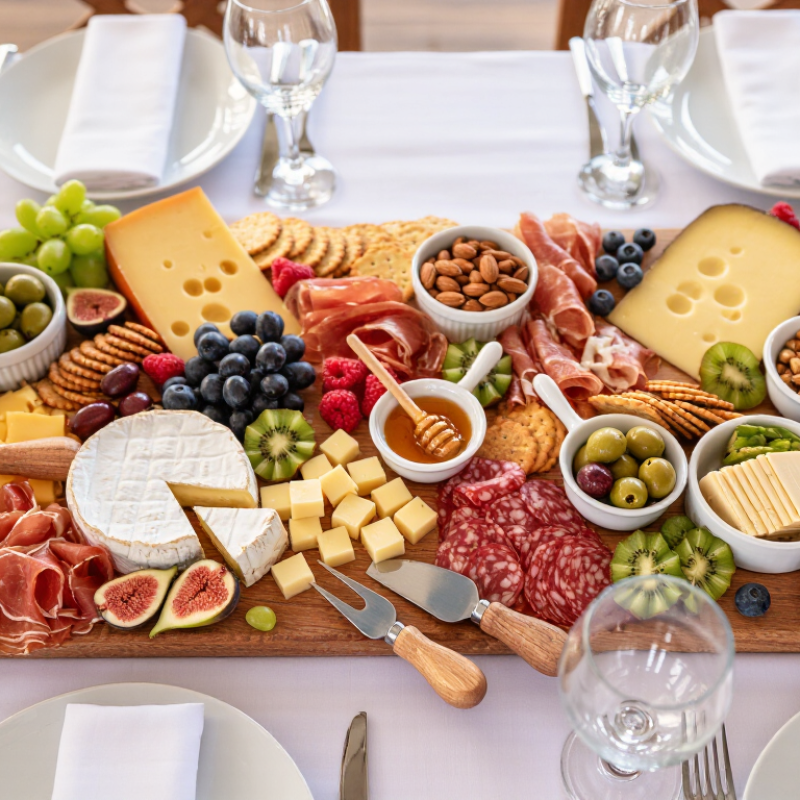
Define Serving Needs Before Comparing Board Sizes and Set Components
Before comparing board sizes, picture the occasion. Are you serving two people after dinner, or setting out snacks for eight guests? A board for four may need room for cheese wedges, folded salami, crackers, and a small bowl of olives. Measure the table space too. A large board can look impressive, but it may leave no room for plates or drinks.
Then match the set components to the food you actually serve. Soft cheese needs a narrow knife; firm cheese is easier to portion with a sturdy blade. Small bowls help contain honey, chutney, or juicy pickles, keeping crackers crisp. If you rarely serve dips, extra bowls may just take up cupboard space. More pieces do not always mean more useful.
Think about serving and cleanup, not only appearance. Can guests reach the food without leaning across the table? Does the board fit your sink or storage shelf? A common misjudgment is choosing a set for a holiday crowd, then using only one knife and half the board on ordinary evenings. That happens. List your usual foods and guest count, then compare dimensions and tools against that list. Add a little room for unevenly cut cheese or an extra handful of grapes; real serving layouts rarely stay perfectly arranged.
Compare Wood, Bamboo, Slate, and Marble for Care and Food Contact
Tip: Check the actual surface, not just the material name. A solid wood board with a food-safe finish can serve cheese, fruit, and cured meats well, but it should not sit in water. Wash it promptly with mild soap, wipe both sides, and let it air-dry upright. Keep it dry. If the finish flakes or deep cuts trap residue, stop using that side for serving.
Bamboo is light and easy to store. Choose a board made for food contact, and follow its care instructions; laminated boards may need gentler cleaning. Avoid soaking bamboo, since moisture can lead to swelling or cracks. Slate offers a smooth serving surface and wipes clean easily, but it can chip if dropped. Its hard surface may also dull knives, so use a separate cutting board.
Tip: Match the material to the job. Marble stays cool, which can help keep soft cheeses firm during serving, but it is heavy and can stain or etch from acidic foods such as citrus. Don’t assume every stone board has the same seal or care needs. I’ve found that a beautiful board is less useful when its upkeep feels fussy, so check the maker’s food-contact and cleaning guidance before buying.
Match Knife Types and Accessories to the Foods You Plan to Serve
A useful charcuterie board set starts with the foods you plan to serve. For firm cheeses, choose a sturdy knife that can cut clean wedges without bending. A narrow, pointed knife helps break hard cheese into smaller pieces. Soft cheeses need a spreader or a short, broad blade. Better control matters more than owning many tools.
Think about the meats, too. A thin slicing knife suits firm salami, while a small fork can hold slices steady. For delicate prosciutto, use a sharp blade and avoid crushing the folds. I used to think one knife could handle everything. It worked, mostly, but soft cheese stuck to the same blade and made serving messy. Separate knives are practical.
Accessories should fit the small details. Add a honey dipper for honey, and short picks for olives or cornichons. Small bowls keep brine and jam from running across the board. A cheese plane is handy for thin slices of semi-firm cheese, but it may be unnecessary if you serve only cubes. Don’t overfill the set. Check that handles feel secure and blades are easy to clean. After serving, wash tools promptly, especially those used with oily meats or soft spreads. Sizing can be tricky; a compact set may look neat but feel cramped when several people reach for it.
Check FDA Food Code Cold-Holding Guidance: Keep TCS Foods at 41°F or Below
An attractive charcuterie board is only useful if its chilled foods stay safely cold. The FDA Food Code sets 41°F (5°C) or below as the cold-holding limit for time/temperature control for safety foods in food-service settings. The Code is a model, so local requirements may differ. Think sliced meats, soft cheeses, cut melon, and dips; check product labels, too. A stone board may feel cool, but touch cannot confirm food temperature.
Choose a set that allows small portions to be replenished, with a chilled insert or nearby ice-filled tray. Keep reserve foods refrigerated at 41°F or below, and bring out only what guests are likely to eat soon. Use a clean food thermometer to check the food itself, not just the serving surface. If food rises above 41°F, chilling it again does not undo the time it spent warm. Follow local guidance for time controls and discarding food. It is easy to underestimate the time when conversation gets lively.
Apply USDA Time Limits: Refrigerate Perishables Within 2 Hours, or 1 Hour Above 90°F
7 Tips for Choosing the Best Charcuterie Board Set?
A beautiful board still needs a food-safety plan. USDA FSIS advises refrigerating perishable foods within two hours, or within one hour when temperatures exceed 90°F. That includes sliced meats, soft cheeses, and cut fruit. Time matters. Choose a set with removable compartments or small serving bowls, so you can replenish portions from the refrigerator instead of leaving everything out.
The CDC estimates that foodborne illnesses cause about 48 million illnesses in the United States each year. Its widely cited estimate appears in Estimates of Foodborne Illness in the United States, published in 2011. A serving board cannot prevent every risk, but cleanable, nonporous surfaces and dishwasher-safe pieces can make careful handling easier. Keep cold foods at 40°F or below, following USDA FSIS guidance, and use a timer during long gatherings.
For a practical setup, serve a modest amount and keep backup portions chilled. Set a phone alarm when food comes out; it is easy to lose track while guests are talking. If the room is hot, use the one-hour limit, even when the board still looks fresh. I would also check whether the set’s bowls are stable and easy to lift. That detail seems minor, until a full bowl tips.
7 Tips for Choosing the Best Charcuterie Board Set
USDA Time Limits for Perishable Foods
Choose a charcuterie board set that makes it easy to serve and promptly refrigerate perishable foods. USDA guidance says perishable foods should not remain at room temperature for more than 2 hours—or more than 1 hour when the temperature is above 90°F (32°C).