
How to Choose the Best Folding Gazebo for Your Business in 2026?

In 2026, choosing a Folding Gazebo is less about picking the largest canopy and more about matching equipment to the work. A weekend market stall needs quick setup, steady shade, and a frame that fits in a delivery vehicle. A hospitality team may care more about frequent assembly, branded panels, and replaceable parts. Small details matter: a jammed leg lock during a windy setup can cost more than a low purchase price saves.

Market reports offer useful context, but they do not measure Folding Gazebo durability directly. Grand View Research’s outdoor furniture market report tracks broader demand for outdoor spaces, not the performance of commercial pop-up shelters. Treat that distinction carefully. Before comparing models, check frame material, canopy fabric specifications, wind guidance, warranty terms, and the availability of replacement components. Then test setup with the people who will use it. In real conditions.

A reliable buying guide should also be honest about its evidence. No verifiable, named Folding Gazebo industry expert quotation or dedicated 2026 market report was provided for this introduction, so attributing a quotation or precise sector statistic would risk misleading readers. The sections ahead focus on practical selection criteria instead: intended use, size, portability, weather suitability, safety, maintenance, and total cost of ownership. A little skepticism helps.
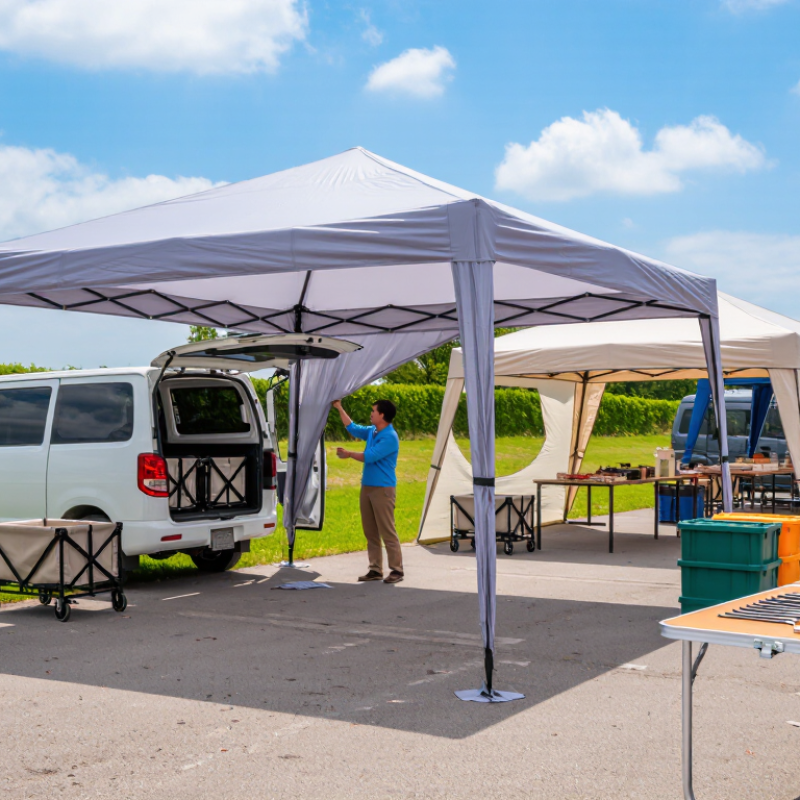
How to Choose the Best Folding Gazebo for Your Business in 2026?

Define Your Business Use Case and Required Canopy Area in Square Metres

Before choosing a folding gazebo, define what your business will do beneath it. A market stall may need room for a counter, stock boxes, and two staff members. A mobile service team might need space for equipment and customers to move safely. Write down the actual layout, not just the number of people expected. Small details matter.

Measure the required canopy area in square metres. Multiply the planned length by the width, then allow extra space for equipment, access, and changing weather. For example, a 3 m by 3 m canopy covers 9 square metres, but its usable area is smaller once tables and supports are in place. Check the leg positions, too; they can obstruct a narrow serving area. A tape measure on the ground helps reveal awkward gaps.

Think about how the space will work during setup and busy periods. Leave clear routes for staff, and avoid placing hot equipment or heavy storage where people pass. If the gazebo will serve different events, list the largest realistic layout rather than an ideal one. This can lead to a slightly larger canopy than planned. Maybe. Measure the site as well, since entrances, pavements, or nearby displays may limit the footprint.

Compare Frame Materials Against EN 13782 Temporary-Structure Safety Guidance

When choosing a folding gazebo for commercial use, compare the complete frame system, not just its material. EN 13782 offers safety guidance for temporary structures, including stability, installation, use, and dismantling. A steel frame can feel rigid under hand pressure, but check tube walls, welds, and locking pins for weak points. Aluminum is lighter to carry and can resist corrosion, yet thin sections or loose joints may flex in gusts. Lighter is not automatically safer.

Ask suppliers for documented load assumptions, setup instructions, and inspection guidance relevant to the exact model. Check how legs connect to the roof, whether joints stay locked, and what anchoring method suits your ground surface. A frame that stands firmly on concrete may behave differently on grass. Keep in mind: material alone does not prove EN 13782 conformity. The standard’s guidance concerns the structure and its safe use, while actual requirements depend on design and conditions. I would also inspect a sample after repeated folding; paperwork can miss the small hinge that starts to wobble. For frequent event use, choose a frame your staff can assemble consistently, then verify its stability before opening the site to visitors.

Assess Fabric Durability Using ASTM D751 and ISO 4892-3 Test Criteria

For a folding gazebo, fabric durability is more than a color chart. ASTM D751 provides test methods for coated fabrics, including breaking strength, tear resistance, coating adhesion, and water resistance. Ask suppliers for the actual test report, specimen details, and results—not just “passes ASTM.” A canopy may resist a sharp tear yet still lose coating adhesion after repeated folding. Small detail. Check seams and corner reinforcements too; fabric tests alone do not assess the complete shelter.

Sunlight needs a separate check. ISO 4892-3 specifies accelerated weathering with fluorescent UV lamps, including controlled UV and moisture exposure. Request the lamp type, exposure cycle, total hours, and any measured change in color or tensile strength. The standard describes a test method, not a direct promise of years outdoors. That distinction matters. ASTM and ISO publish methods, not a universal pass score for every gazebo fabric. Compare reports using the same conditions, and treat broad claims without figures cautiously. A useful purchasing file pairs D751 results with ISO 4892-3 exposure data and notes the fabric’s coating, weight, and color. Real field performance can still vary; that is worth admitting.

How to Choose the Best Folding Gazebo for Your Business in 2026? — Assess Fabric Durability Using ASTM D751 and ISO 4892-3 Test Criteria

Fabric construction Typical commercial use ASTM D751 checks to request ISO 4892-3 assessment Practical buying considerations
Coated woven polyester Markets, short-term events, and general outdoor shelter Ask for the applicable coated-fabric test results for breaking strength, tear strength, coating adhesion, and hydrostatic resistance. Compare results using the same specimen direction and test conditions. Request a report identifying the lamp type, exposure cycle, duration, and appearance or strength changes after exposure. ISO 4892-3 specifies fluorescent UV exposure methods; it does not set one universal pass/fail limit for gazebo fabric. Check coating uniformity, seam construction, and whether the supplier provides results for the finished fabric rather than an unrelated material.
Solution-dyed polyester with a protective coating Repeated seasonal use where color retention matters Review breaking and tear strength, coating adhesion, and water-resistance results under the stated ASTM D751 procedures. Confirm that the reported values meet the purchaser’s written specification. Use documented UV-aging results to compare color change, cracking, embrittlement, or retained strength. Specify the exposure conditions and the acceptance criteria before testing. Ask for color-change data and inspect stress points, stitching, and reinforcement patches. UV results alone do not establish wind or structural safety.
Heavier coated polyester Frequent setup and takedown at trade shows or service locations Prioritize tear strength, breaking strength, coating adhesion, and hydrostatic resistance. ASTM D751 is a test-method standard; the required performance values should be set in the purchase specification. Compare post-exposure condition and retained properties using the same ISO 4892-3 procedure and comparable exposure duration across samples. Higher fabric mass does not by itself guarantee longer service life. Evaluate packed weight, ease of handling, repair options, and water drainage design.
Coated polyester with a light-colored or reflective surface Outdoor promotions and locations where reducing radiant heat is a priority Request the same strength, tear, adhesion, and water-resistance results, and check that the surface finish does not compromise coating adhesion or seam performance. Ask whether UV exposure causes fading, chalking, cracking, or loss of coating integrity. Define acceptable changes for the intended service life. Light color and reflective finishes may affect heat gain, but do not replace shade measurements or ventilation planning. Confirm cleaning instructions and finish durability.
How to set a defensible specification Applies to any fabric option Request the test edition, procedure, specimen preparation, conditioning, test direction, number of specimens, and individual or average results. State buyer-defined minimum values; do not treat a test method as a universal grade. Specify the fluorescent lamp (for example, UVA-340 where appropriate), cycle, exposure duration, and the property or visual change to be assessed. Compare only reports using equivalent conditions. ASTM D751 evaluates coated fabrics through specified test procedures, while ISO 4892-3 describes fluorescent UV exposure methods. Neither standard alone certifies a complete gazebo or establishes suitability for every climate.

Verify Flame Performance Against NFPA 701 Requirements for Tent Fabrics

When choosing a folding gazebo for business use, check flame-test evidence for the exact canopy fabric—not just a general “fire-resistant” claim. NFPA 701:2023 sets out two test methods for flame propagation in textiles and films. The appropriate method depends on factors such as material construction and intended use. Ask for a current laboratory report naming the fabric, coating, and test method. A certificate for a similar-looking fabric may not cover your canopy.

Look for the measured results, test date, and laboratory details, then compare them with the applicable NFPA 701 criteria. This standard evaluates how specimens respond to controlled flame exposure; it does not mean a canopy is fireproof. Keep the report with purchasing records, and check that replacement panels use the same tested material. Small changes in coating or fabric weight can matter. Paperwork can look reassuring, but it deserves a careful read.

Tips: Before ordering, request the full report and confirm the tested sample matches the canopy’s color and finish. Ask how the supplier tracks material changes. NFPA 701:2023, Standard Methods of Fire Tests for Flame Propagation of Textiles and Films, is the primary technical reference; have a qualified fire-safety professional review unclear results. A label alone is not enough.

How to Choose the Best Folding Gazebo for Your Business in 2026

A practical planning guide for evaluating flame-performance documentation alongside everyday business needs.

The percentages are illustrative buyer-planning weights, not measured market data or NFPA 701 pass criteria. NFPA 701 provides test methods for flame propagation of textiles and films. Ask for a test report identifying the tested fabric and applicable method, and confirm that it matches the material offered for your gazebo.

Compare Setup Time, Warranty, Replacement Parts, and Total Cost of Ownership

A folding gazebo can look sturdy in a product photo and still feel awkward when two people assemble it in a gusty parking lot. Before buying for 2026 events, compare setup time under realistic conditions. Ask how many people are required, whether tools are needed, and if the frame locks are easy to reach. A timed trial on a flat surface is useful; repeat it after packing the unit away. One quick setup is not enough.

Warranty terms deserve a close read. Check which frame and canopy components are covered, for how long, and what wear or weather damage is excluded. Then ask whether replacement legs, connectors, and canopy panels can be ordered separately. A small missing connector should not force you to replace an entire shelter. Keep the answers in writing. Details matter.

Tips: Estimate total cost of ownership, not just purchase price. Include likely replacement parts, storage, transport, and labor for setup and repairs. For example, a heavier frame may last longer but take more staff time to move. Compare costs across your expected event days, and leave room for uncertainty. We once underestimated how often a canopy would be packed wet; that was a planning mistake, not a product defect. Check drying and storage needs before committing.

Request More Information